
In the high-stakes world of construction, everyone wants to talk about the “grand opening”—the ribbon-cutting, the gleaming glass, and the polished concrete. But for Quantity Surveyors (QS) and project managers, the real magic (and the real tragedy) happens long before a single shovel hits the dirt.
If you’ve been in the industry for any length of time, you’ve seen it: a beautiful architectural concept that ends up gathering dust on a shelf because the tenders came back 30% over budget. This isn’t just a failure of math; it’s a failure of preliminary cost planning.
1. The Myth of the “Square Meter Rate”
Early in a project’s life, clients often push for a quick number. “What’s the cost per square meter?” they ask. While historical data is a helpful compass, relying solely on it is like trying to predict the weather in six months based on today’s temperature.
Why the “Quick Math” Fails:
- Site Specifics: You can build the same warehouse twice, but if one site has poor soil quality requiring piled foundations, your “standard” rate is out the window.
- Market Volatility: As we’ve seen in recent years, the price of structural steel or timber can swing wildly in a single quarter.
- Design Complexity: A 2,000 $m^2$ box costs significantly less than a 2,000 $m^2$ L-shaped building with a cantilevered roof.
2. The Power of Elemental Cost Analysis
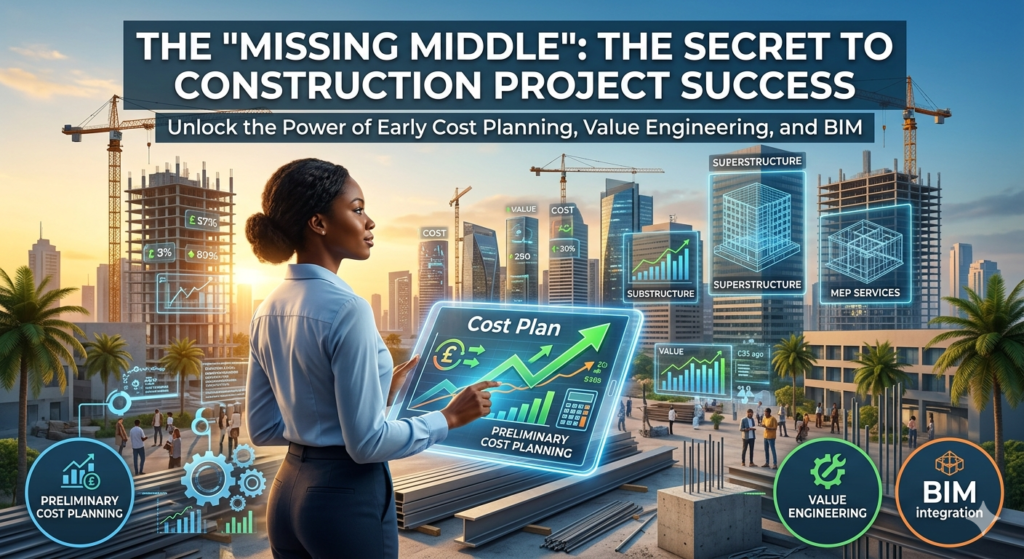
A professional QS doesn’t just look at a building as a whole; they break it down into its DNA. This is where Elemental Cost Analysis (ECA) comes into play. By dividing the project into functional elements—Substructure, Superstructure, Internal Finishes, and MEP (Mechanical, Electrical, and Plumbing) Services—we can identify where the money is actually going.
Pro Tip: In modern commercial builds, MEP services can account for 30% to 50% of the total construction cost. If you aren’t scrutinizing your services early, you aren’t actually cost-planning; you’re just guessing.
3. Value Engineering: It’s Not Just “Cutting Costs”
There is a common misconception that Value Engineering (VE) is just a fancy term for “making things cheaper.” That couldn’t be further from the truth. Real VE is about maximizing the Function-to-Cost ratio.
The formula for value is often expressed as:
$$Value = \frac{Function}{Cost}$$
If we can swap a specific cladding material for one that offers the same aesthetic and thermal properties but costs 15% less, we’ve increased value. If we cut the quality of the HVAC system to save money, but the maintenance costs double over ten years, we’ve actually decreased value. A great QS acts as the conscience of the project, ensuring long-term viability over short-term savings.
4. Risk Management: The Contingency Trap
Many developers view “Contingency” as a slush fund. In reality, it should be a calculated figure based on a Risk Register.
Early-stage projects usually carry a higher contingency (often 10-15%) because the unknowns are vast. As the design progresses and we move from “Estimating” to “Budgeting,” that percentage should shrink. If you’re still carrying a 10% “General Contingency” at the Pre-Tender Estimate stage, you haven’t done enough work on your risk allocation.
5. Embracing Technology: From Blueprints to BIM
The days of a QS sitting with a scale ruler and a highlighter are fading. Building Information Modeling (BIM) has revolutionized the “Take-off” process.
The BIM Advantage:
- Automated Quantities: 5D BIM allows us to extract quantities directly from the 3D model, reducing human error.
- Clash Detection: Finding a pipe running through a steel beam on a screen costs $0. Finding it on-site costs thousands.
- Live Updates: If the architect changes a wall type, the cost plan can update almost instantaneously.
Final Thoughts: The QS as a Strategic Partner
The most successful construction projects are those where the Quantity Surveyor is brought in at the Inception Phase, not just the Tendering Phase. When the QS works alongside the Architect from Day 1, they create a “budgetary envelope” that allows creativity to flourish within the bounds of reality.
Construction is a risky business, but it doesn’t have to be a gamble. Through rigorous cost planning, elemental analysis, and a commitment to true value engineering, we can turn “over-budget” nightmares into “on-time” success stories.
Are you planning your next build based on a hunch, or based on a cost plan? Let’s get the numbers right before the first brick is laid.